How it works
From a noise you can’t name to a total you approved.
Four steps, and each one turns a guess into something you can act on: which vehicle you drive, what the noise probably is, which nearby shop takes that work today, and what you’re actually paying for. Every screen below is the real thing.
You arrive with“a truck, some kind of V6”
You leave with2021 Ford F-150 · 3.5 L 6 cyl
Pin down your vehicle
Everything after this is filtered by the vehicle you actually drive. That is why it goes first.
Three ways in. Photograph it, and a code goes to your phone so you can shoot the vehicle or its VIN plate wherever it is parked. Type the seventeen characters yourself. Or pick it from the list, which is the fastest route when the vehicle is not in front of you.
The list narrows as you type, and it narrows honestly. Pick Ford and the models are Ford’s. Pick a year and the engines are the ones that year’s F-150 actually shipped with — five of them, and which one you have changes both the parts and the hours.
Whatever you identify stays in your garage. Next time something happens you start from a vehicle instead of a blank box, and the shop gets the same details you saw.
- The engine is not a detail. A 2.7 and a 5.0 in the same truck are different jobs at different prices.
- Skip what you don't know. Engine is optional. You can fill it in later, or let the shop confirm it.
- A shop can vouch for it. When a shop checks your VIN in person the vehicle carries a Verified badge from then on.
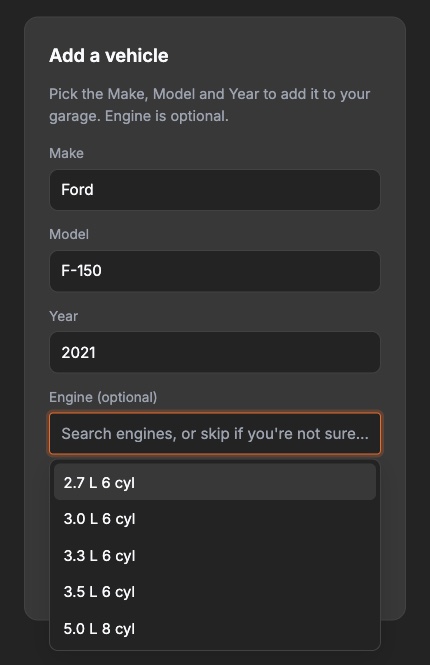
Those five engines are the ones Ford built that year’s F-150 with. The list comes from the vehicle catalog, not from a text box.
You arrive with“it idles rough and smells like fuel”
You leave witha short list of likely causes, in order
Understand what’s going on
Describe it the way you would to a friend. Get back a plain answer about your vehicle, not a forum thread about someone else’s.
You type what it is doing — the noise, the smell, the light, when it happens. The answer comes back about the vehicle you picked in step one, by name, because a rough idle on a 2021 F-150 has a different shortlist than a rough idle on something else.
It tells you what is most likely, how serious it is, and what to do about it now. Where the honest answer is stop driving, it says so. Where the honest answer is get the code read first, it says that instead of guessing past it.
The point is not to hand you a diagnosis. It is to get you to the counter able to say what the vehicle is doing, so the conversation starts somewhere useful and the shop is not charging you to work out what you already knew.
- It is an AI, not a mechanic. It can be wrong, and it says so on every screen. A shop confirms the cause with the vehicle in front of them.
- It knows your vehicle. Answers are written against the year, make, model and engine you identified.
- It carries forward. What you describe here becomes the summary the shop sees in step three.
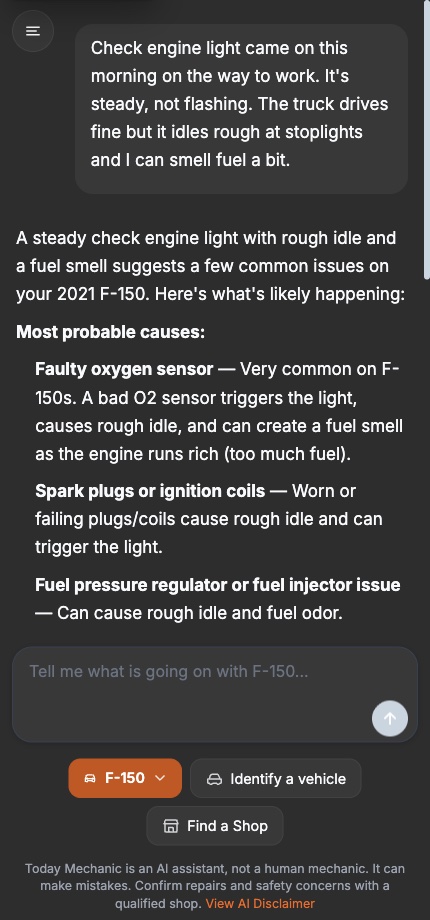
A real answer from the running app. The vehicle it names is the one identified in step 01.
You arrive with“someone near me who can look at it”
You leave witha named shop, Wednesday morning
Find a shop today
The problem you just described becomes the search. You are matched to shops that take that kind of work and have room.
The summary is written for you from the conversation, and you can edit every word of it before it goes anywhere. Underneath it are the services it matched on — emissions, engine diagnostics, domestic makes — which you can add to or take away. Those tags decide which shops rank for you.
Then it is distance, a date, and a part of the day. Morning, afternoon or evening rather than a rigid slot, because a shop knows its own bay better than a booking form does. The windows come off each shop’s real opening hours, so an eight-to-noon morning at one shop and a seven-to-eleven morning at another both say what they mean.
Shops already on Today Mechanic show their openings and take the request in the app. Shops that are not appear underneath, from Google, with their number — because the honest answer to "who can see me today" sometimes involves a phone call.
- Edit the summary. It is the first thing the shop reads about you. It is yours to correct.
- Windows, not slots. Pick a part of the day. The bands follow each shop’s own hours.
- You are told which is which. Bookable shops and call-them-yourself shops are labelled, never blurred together.
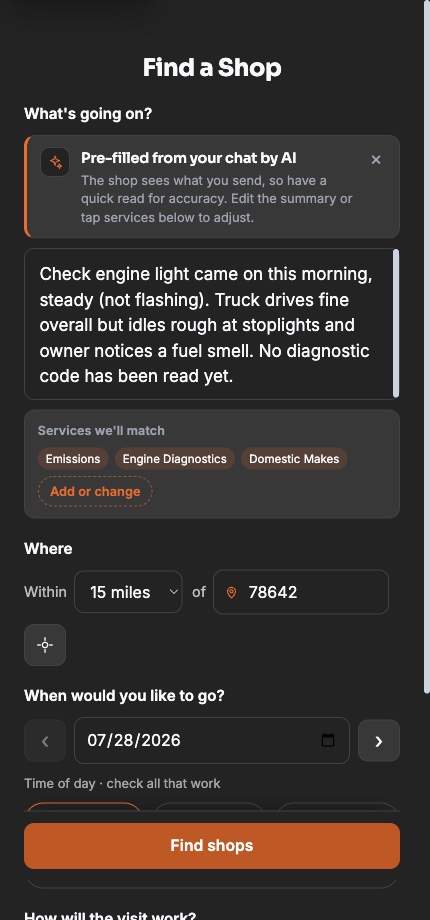
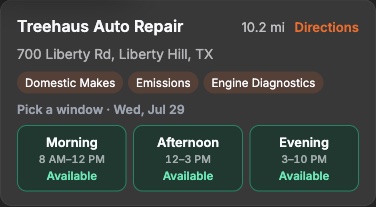
Demo data on a test account. The three tags are the ones the search matched, and the windows are that shop’s own hours.
You arrive with“whatever it ends up costing”
You leave withfive lines, and you said yes to two
Approve by text
The estimate arrives as a link. You go down it line by line, and nothing starts until you have.
No app to install and no account to make — the link is the credential. Each line carries what it is, what it costs, and a note from the advisor explaining why it is on there. They are grouped by whether the shop considers them critical, due on mileage, or optional.
You approve what you want and leave the rest. Anything you are unsure about goes back as Discuss with your question attached, rather than a flat no the advisor has to phone you about. The cabin air filter can wait until next time and the oxygen sensor can go ahead today, and that is one decision, not an argument.
From there the appointment page tracks itself. It moves from checked in, to reviewing your estimate, to ready for pickup, and you get a text at the far end when the vehicle is done.
- Line by line. Take the sensor now, leave the filter for next visit.
- Discuss, not decline. An unsure line goes back with a question on it instead of a no.
- Nothing starts unapproved. A lift is never tied up by work nobody has said yes to.
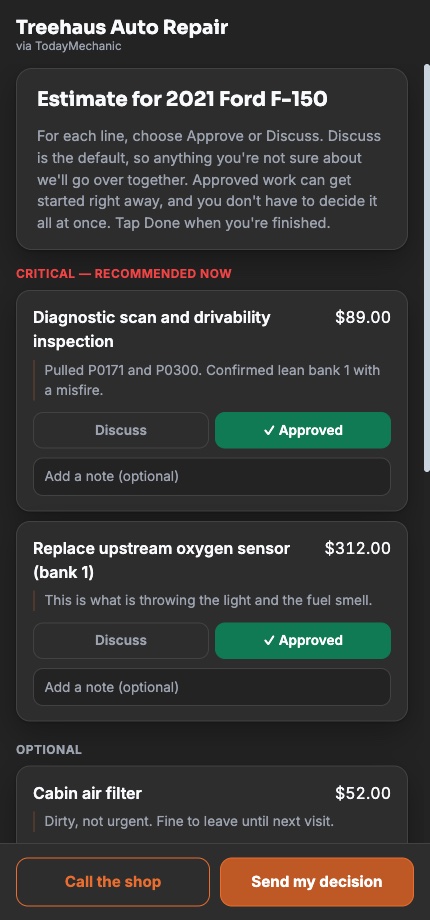
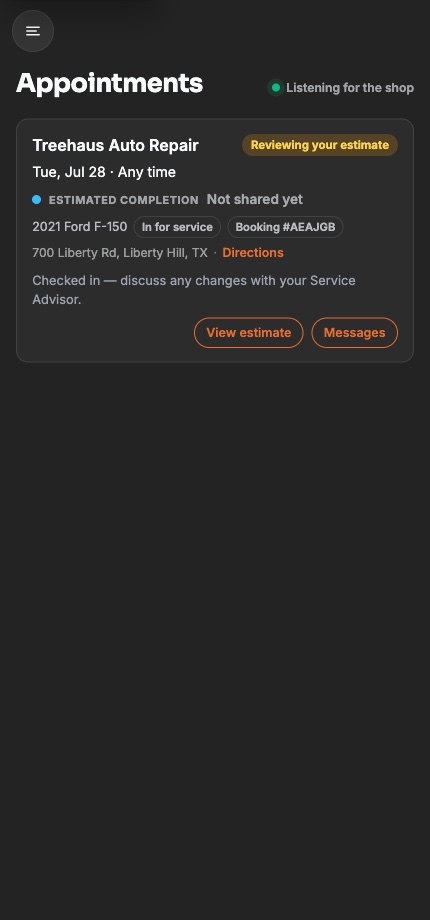
Fictional booking on a test account. The status pill changes as the shop works, without a refresh.
That is the whole of it.
Identify the vehicle once, describe the problem in your own words, pick a shop with room today, and approve the work before anyone starts. You pay the shop, the way you always have. Today Mechanic is free for drivers.